Couch to Club
presented by
Tonight on the couch
Culture Trails
runpacks.app/culturetrails
Social trail runs in the hills around Limassol every Sunday at 8, routes checked first on a recon run, and coffee brewed out of the back of the car at the end. In their own words.
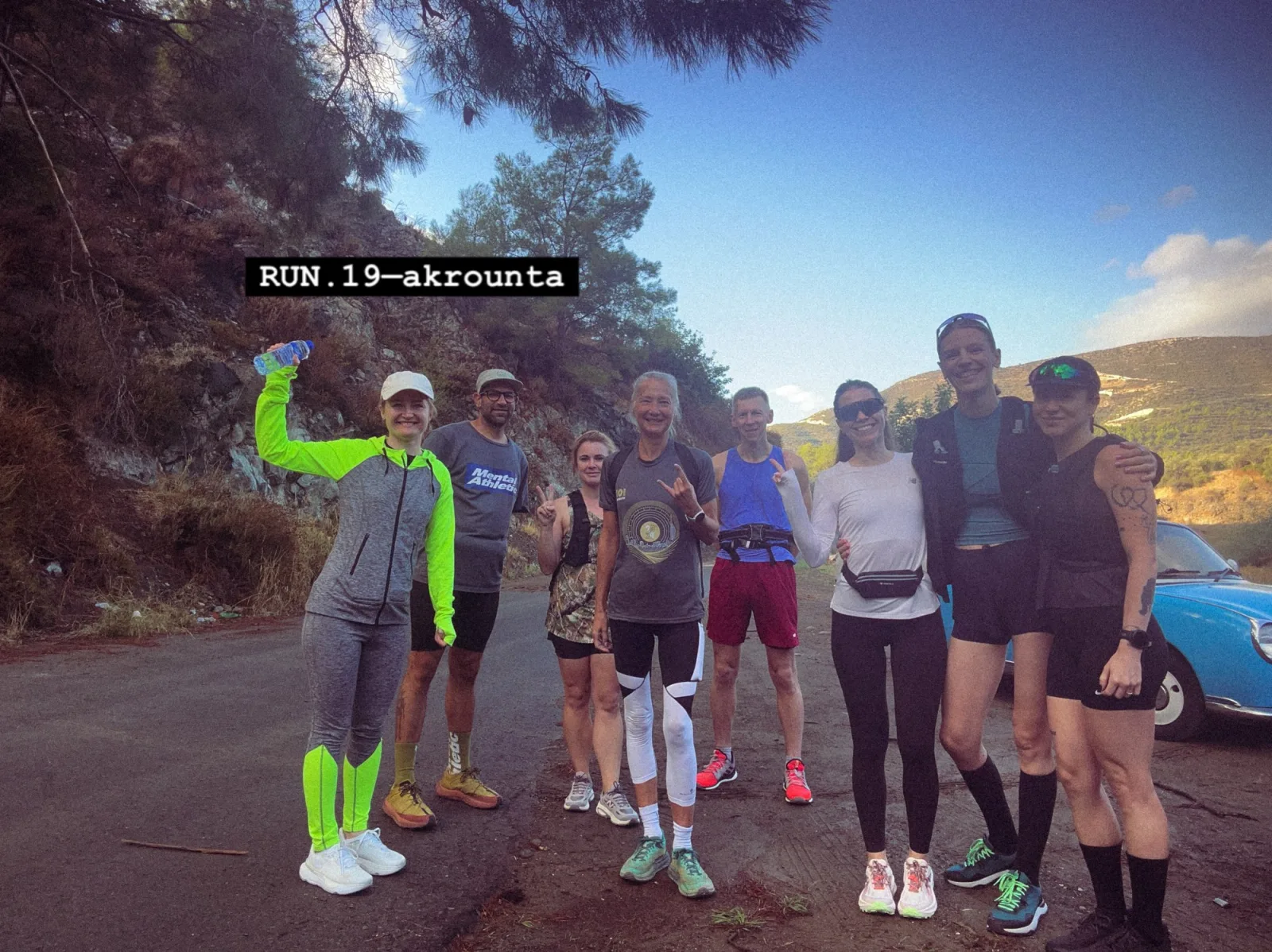
 @culturetrailruns1 of 19
Couch to Club
presented by
Tonight on the couch
runpacks.app/culturetrails
Episode 4 · 20 min · In English
Follow the showRSS feed
Transcribed automatically.
So imagine you're like halfway up a mountain in Cyprus.
Okay, I am picturing it.
And you're looking at this topographic map on your phone, right? And the little blue line says there is a road literally right in front of you.
Right, the trusty map app.
Exactly. But in reality, you look up and it's just a freshly cultivated field. Like the trail you were supposed to follow has completely vanished.
Oh man, yeah, that is the worst feeling.
Right? And if you're leading, you know, a typical city running club, this is the part where everyone kind of panics.
Oh, absolutely. The smartwatches start beeping. People are checking their pace. The whole workout is just totally derailed.
Totally derailed. But we are diving into a really fantastic piece of source material today. And for this one highly specific group, that disappearing map isn't a disaster at all.
It's like a feature, not a bug.
Exactly. It is exactly why they showed up. Welcome to today's deep dive. We are looking at an interview created for Couch to Club, which is a series on the Runpacks app about Cyprus Run Clubs.
Yeah, and today we're focusing on a trail running club called Culture Trails. Right, Culture Trails.
They operate in the hills around Limassol. And our mission today is to really unpack how they use the trails as this gateway to local culture, community, and just pure discovery.
It's such a fascinating vibe. It's not about personal records or split times at all.
No, not at all. It kind of reminds me of, well, you know how a standard city running club can sometimes feel like a networking event.
Oh, for sure. Everyone's comparing marathon times and shoe brands. Right.
But Culture Trails sounds more like, I don't know, a secret society dedicated to local exploration. But before we get into the disappearing roads and all their amazing post-run rituals, I have to ask a foundational question. Lay it on me. Isn't running inherently about pushing physical limits? Like, how do you take a group of runners and just completely strip away that natural human urge to compete?
Well, you do it by fundamentally changing the environment and, honestly, the stakes. If you look at the origin story of Culture Trails, it didn't start with some grand sweeping philosophy about community.
Right. It was much more personal than that.
It was. It started with a physical limitation. The founder, and we're just going to call them the founder today because they don't actually give their name in the Couch to Club interview. They messed up their back last winter. Ouch. Yeah. Yeah.
That is a runner's nightmare.
It really is. So they had to make this incredibly hard rule for themselves, which was simply no races this year. Wow.
So just a total reset. Precisely.
And when you remove the finish line, the whole psychology of the workout changes. Your brain is no longer, you know, calculating split times or worrying about a personal best.
And you're just out there.
Exactly. The founder spent hours and hours just training alone in the mountains around the village of Apsiou. And it was up there that a completely different kind of motivation took root.
Which brings up the geography of this whole thing because that detail is just so fascinating to me. Apsiou is only a 20-minute drive from the coastal city of Limassol.
Just 20 minutes. Right. It's so close. Right.
But the founder noted that after a few hours up there in the mountains around Apsiou, it felt completely disconnected. Like it was far away from absolutely everything. Yeah, that contrast is huge. It is. I mean, 20 minutes is nothing. You can spend 20 minutes looking for parking in a city. How does such a short drive create that massive of a mental shift? Well, it really comes down to how our brains process different environments.
In a busy coastal city like Limassol, your brain is in this constant state of like low-level hypervigilance.
Oh, like sensory overload. Yeah.
You're processing traffic. You've got crowds, noise, concrete structures everywhere. But when you drive 20 minutes into the hills, you cross this invisible threshold.
The sensory input just completely changes. Exactly.
Your nervous system shifts out of that urban hypervigilance and into what environmental psychologists call soft fascination.
Soft fascination. I love that term. It's great, right? Mm-hmm.
That natural environment basically holds your attention without requiring this massive draining cognitive effort. So that 20-minute drive isn't just a physical displacement. It's this profound psychological decompression.
And the founder really wanted other people to feel that exact decompression. They actively chose not to be just another run group down in the city by the coast.
They wanted to share that feeling of being far away.
Right. So they hosted their very first run starting from the monastery of Panagia Amirous. What a beautiful place to start a run. I know, right? And it was super humble beginnings. Just seven people showed up. Basically friends and friends of friends.
But the loyalty that first run inspired is wild.
It is. Yes. The interview notes that some of those original seven people still come almost every single week.
Which is amazing.
Mm-hmm.
And you have to ask, why do they stay if there's no race to train for? Right.
There's no medal at the end of the season.
Exactly. Because loyalty like that doesn't stem from a shared desire to burn calories. You know, it comes from a shared ritual. Oh, for sure. Starting a run at a historic monastery instantly signals to the group that they are doing something a bit more significant than just a workout. They are participating in an exploration.
And that connection to exploration is literally baked right into their name. Culture Trails. Yeah. I was so curious how a trail running group ended up with a name like Culture Trails. A good friend of the founder is actually the one who coined the name. But it stems from this incredibly ambitious broader plan.
They wanted to eventually bring visitors to Cyprus through trail running and hiking, right? Yes.
But they knew they needed to start locally first. And the founder described the idea so perfectly in the interview. I actually want to read their exact words here. Yeah, let's hear it. Okay. They wanted to focus on, quote, discovering Cyprus and its different terrains, its people and villages, crafts and other experiences through trail running.
See, blending physical exertion with cultural crafts is just a highly unusual approach.
It really is.
Normally, we keep those pursuits totally separate. You do your Sunday long run in the morning, you get super sweaty, and then maybe, I don't know, you shower and visit a museum or a workshop in the afternoon.
Well, let me tell you how they actually merged those two things. Because the Couch to Club interview details session 18, which took place in a village called Foini.
Oh, the famous culture session. Yes.
They explicitly dubbed it the culture session. So first, they do a route led by one of their members. And it takes the group up through the forest high above the Trooditissa River.
Sounds gorgeous. Right.
Then they finish the run and they stop at the village kafenio.
The local coffee house. Perfect.
And then this is the crazy part. After that, the whole running group heads over to a studio in Foini to try lino engraving and printmaking with the Troodos Art Club.
That is just incredible. If we look at the cognitive science behind that exact sequence, it is honestly a master class in experiential learning.
Wait, really? Break that down for me. Because, I mean, carving linoleum after a trail run sounds fun, but what is it actually doing to the brain?
Think about the physical state of the runners at that moment. They've just navigated uneven terrain through a forest. Their heart rates are elevated. Oxygen flow to the brain is absolutely maximized. And their sensory awareness is completely heightened.
Okay. So they are physically buzzing. Exactly.
And if you take that highly primed neurological state and you immediately anchor it to a fine motor, culturally specific task, like lino printmaking, you are fundamentally altering how that memory is stored.
Oh, wow. So it sticks with you longer.
Much longer. You are actively linking the physical exertion of the land to the cultural expression of the village itself. The runners aren't just passing through Foini as tourists. They are participating in it. It creates this deeply embedded memory of the place.
If you are listening to this deep dive right now and you're like on a treadmill staring at a blank gym wall, just imagine how different your workout would feel if your final destination was a local art studio instead of just reaching a calorie count on a digital screen.
It changes the entire paradigm of what a run can be.
It totally does. But obviously, orchestrating that kind of experience hidden up in the mountains takes some serious work.
Oh, the logistics must be intense.
Yeah, the founder mentioned spending hours and hours just poring over topographic and satellite maps, plotting out different versions of the distance on an app. And crucially, they always do a recon run first.
Which is absolutely essential. I mean, we suffer from something called cartographic illusion in the modern age.
Cartographic illusion.
Yeah, we tend to trust the glowing digital map on our phone more than the physical reality right in front of our eyes. But, you know, a satellite image from two years ago isn't going to tell you that a trail has been swallowed by a landslide.
Or reclaimed by agriculture. Which is exactly what happened to the founder. They learned that lesson the hard way during Run 20 at Mathikoloni.
Oh, the Mathikoloni incident.
Yes. So the plan was this 10.7 kilometer loop. It featured about 331 meters of climbing on these white limestone tracks.
Sounds like a solid route.
It does on paper. But during the actual run, the group had to turn back a couple of times because roads that definitely existed on the map had completely disappeared in reality. Just gone? Completely gone. Cultivation and new roads had just been built right over them.
The Earth literally overwrote the map.
It did. But I have to push back a little here. Just looking at those numbers. 10.7 kilometers, 331 meters of climbing. For anyone who actively follows running content, that's basically just a moderately hilly route. Right.
They aren't scaling Mount Everest.
Exactly. So why does a missing trail on a moderate run matter so much? Does it really ruin the day?
Well, it's not really about the elevation profile or the distance. It's about the technical shift in the terrain and the psychological friction it causes.
What do you mean by psychological friction?
When you run on a city sidewalk, the surface is totally predictable. Your brain can effectively go on autopilot. You can zone out and listen to music.
True. You don't even look at your feet.
But when you are out on white limestone tracks in Mathikoloni, the footing is entirely unpredictable. Every single step requires these tiny micro adjustments.
So you have to be present.
You have to be. And when the trail suddenly vanishes into a plowed field, that autopilot is violently interrupted. Now, for a hyper-competitive roadrunner, that interruption is incredibly frustrating. It ruins your pace.
Right. I'd be so annoyed. But for a group built around discovery, that friction is the entire point.
It forces adaptability. It shifts the whole dynamic from simply following a designated leader to, you know, collectively navigating the unknown.
It becomes a shared problem to solve. And that collective mindset really dictates, you know, like what their Sunday, like exactly how that functions.
Let's talk about their Sundays because the structure is like, it's so intentional.
It is. So they usually will do like an 8 a.m. meet and greet. They run. They chat. But the most important rule is that they constantly stop and regroup so absolutely nobody is left behind.
I love that.
Me too. And they intentionally take time to look around, snap photos, and just soak in the landscape.
Which reinforces that the landscape isn't an obstacle you're trying to conquer as fast as possible. It's the actual subject of the activity.
Exactly. Wait, no, I shouldn't say exactly because the founder actually argues the run itself is almost secondary. Really? Yeah. They see the best part comes at the end. I have to read the quote describing their post-run ritual because it is just perfect.
Go for it.
Quote, on the spot coffee out of the back of the car and homemade post-run fuel.
There is a profound neurobiological shift happening during that specific ritual at the back of the car.
Okay, break that down for me because on the surface it just sounds like some people drinking coffee in a dirt parking lot. Fair enough.
But think about what's happening internally. When you are out on the trail navigating limestone and climbing hills, your sympathetic nervous system is engaged.
That's your fight or flight response, right? Exactly.
Your body is pumping out cortisol and adrenaline to keep you moving over rough terrain. But the moment you finish the run and gather around the back of that car for coffee, you trigger this massive shift to the parasympathetic nervous system.
The rest and digest state. Yes.
And the details matter here. The founder is preparing a cold brew ahead of time. They are bringing a French press to make hot coffee right there at the trailhead.
I mean, a French press at the trailhead, that is next level hospitality.
It really is. And they use locally roasted coffees to discover local coffee culture. And they share treats, stuff homemade by the founder, bought from a favorite spot, or brought by a runner.
Sharing food and a warm drink like that?
It releases oxytocin and dopamine.
It's an ancient human mechanism for tribal bonding. Honestly, that tailgate coffee ritual builds trust faster than a hundred corporate team building events ever could.
Hospitality in the wild.
But, you know, even with the promise of a French press at the trailhead, trail running can still sound super intimidating if you're a runner who has only ever pounded flat, predictable pavement.
Oh, that is definitely the primary barrier for roadrunners. They assume you need, like, this specific type of elite athleticism to venture off the asphalt.
Well, the founder addresses that hesitation directly in the interview. And their advice is incredibly grounding.
What do they say?
They emphasize that culture trails moves at a strictly social pace. The golden rule is that everyone sticks together. And they explicitly state that it is accessible even if your only experience is hiking.
So they just strip away all the elitism of outdoor sports.
Totally. The main idea isn't athletic dominance at all. It's simply having a good time with people in a scenic environment and disconnecting from the city even if just for a little moment of the week.
And getting away from the city often means returning to deep local roots, right?
Yes. Which brings us right back to where the club began. We have to talk about Apsiou again.
The founder has such an intense connection to that area.
They really do. They've spent countless hours there, digging into its local mining history and the stories of the village itself. They mention that a favorite route includes the trails leading up to the Kakomalis fire lookout. Because the views are just incredible.
And that kind of deep dive into one village naturally sparks a broader urge to explore, doesn't it?
Oh, absolutely. The founder talked about this growing curiosity, just constantly wondering what trails exist around other villages. Places like Akrounta, Episkopi. They basically want to hit them all.
It turns the whole map of Cyprus into a canvas. Right.
And I love how they summed it up. They said, quote, it's such a great way to learn more about your Cyprus. Not the generic tourist version, but the breathing, tactile reality of the land.
That is beautifully put. But, you know, with all these incredibly diverse experiences, from the lino printmaking in Foini to navigating the disappeared roads of Mathikoloni, I'm curious what stands out as their pinnacle achievement. Like, what is the run nobody will ever forget?
Well, the Couch to Club interview asked that exact question. And the founder's answer was so surprising.
What was it?
They said they aren't sure it has actually happened yet. Really? Yeah. Because the people change every single week, they feel like every run is totally unique. But they do have a dream scenario for what that unforgettable run will eventually be.
What's the dream?
They want to introduce a long run, something two to three hours plus, and reach one of the four high peaks of Cyprus.
That makes perfect sense. Yes. Extended shared endurance is the ultimate social glue.
Because you're suffering together.
Basically, yeah. A one-hour social loop is fantastic for community building, but when you are out in the elements for three hours, fighting fatigue, and finally reaching a high peak together, those relationships are forged in a completely different fire.
Well, speaking of things that haven't happened yet, the Couch to Club interview format includes this really fun feature at the end. They sent the club a six-question this or that rapid-fire round.
Oh, I love a lightning round.
But because the feature was published before the club's answers came back, nobody actually knows Culture Trails' official picks yet.
So it's a built-in mystery.
Exactly. So we are going to play the game on their behalf right now.
I am so ready.
And to you listening, let me make this very clear. These are completely unofficial, playful guesses based purely on our reading of the interview. The club's real picks are coming soon. Are you ready to psychoanalyze a run club?
I will do my absolute best.
Okay. Question one. Uphill or downhill?
Hmm. Based on their love for the trails up to the Kakomalis fire lookout, I have to guess uphill. The climb seems to be where the magic happens for them.
I lean toward uphill, too. Okay. Question two. Cold brew or French press?
Oh, this is tough because they explicitly do both at the trailhead.
They do.
But taking a French press into the mountains feels like such a deliberate grounding ritual. I'll guess French press.
I'm with you on the ritual aspect. It just feels so specific. Number three. Apsiou or Foini?
Oh, it has to be Apsiou. It's the sanctuary where the founder spent hours training alone after the back injury. It's the origin point.
It's hard to argue with the origin story. Number four. Short and steep or long and slow?
Definitely long and slow. The founder explicitly talks about a social pace, keeping everyone together, and dreaming of those multi-hour peak runs.
Totally agree. Number five. The village kafenio or the back of the car?
Well, the kafenio in Foini was a massive cultural hit, but the founder literally called the coffee out of the back of the car the best part.
I'll guess the back of the car. It really is their signature move. Okay, last one. Number six. Plan the route or get lost?
This is a trick question. They pore over topographic and satellite maps for hours, and they do recon runs. But the most memorable stories seem to happen when the maps lie. I'm going to guess they secretly love to get lost.
A rogue choice. I love it. Now, for everyone listening, we want you to jump into the comments on the Culture Trails Instagram post and drop your own guesses. Remind them what they think. The club will be revealing their actual answers really soon.
It's a brilliant way to keep the community engaged, even when they aren't out on the trail.
It really is. And to wrap up the Couch to Club interview, there was one final question about a place they still dream of running. And it involves even more map reading. Of course it does. The founder admitted they've been getting lost on computer maps lately, dreaming of exploring the deep, remote trails of the Paphos forest and the areas north of it.
Paphos forest? That sounds incredible.
But they included this incredibly funny, grounded caveat. Quote, let's see if I get the green light from my wife.
The ultimate topographical obstacle for any explorer.
Truly the final boss. If you want to see the full Couch to Club story, complete with amazing photos of these trails and those intricate coffee setups, check it out on runpacks.app.
The photos really bring it all to life.
They do. And just as a quick reminder on logistics, Culture Trails runs every Sunday at 8 in the morning from a different village in the hills around Limassol. It is a social trail run for absolutely everyone.
So don't be intimidated.
Exactly. You can find the starting points posted early in the week on Instagram by following at culturetrailruns.
You know, taking a step back from Cyprus for a moment, there is a philosophy here that applies no matter where you live.
How so?
Think about that 20-minute threshold we discussed earlier. Look at a map of your own local area.
Where is that spot?
Just a 20-minute drive away where the map's roads might completely disappear, the cell service drops, and you can simply disconnect.
That is a great question to ask yourself. Right.
What is your personal Culture Trail waiting to be discovered?
Culture Trails runs on Sunday mornings from a different village each week, in the hills around Limassol. We asked how it started.
It sort of all started because this year I told myself I wouldn’t do any races as I messed my back up last winter. And then the idea of creating a trail group came naturally as I always wanted to share the outings I did on my training in the Apsiou region with people.
I always found myself to go on runs for hours sometimes in the mountains there and yet I was so close to Limassol, like a 20 minute drive, yet after a few hours in there it felt like it was far away from everything. So I wanted people to come and experience that and not just be another run group in the city by the coast.
The first run set off from the monastery of Panagia Amirous, just outside Apsiou. They were seven, friends and friends of friends, and some of them still come almost every week.
In October the club followed a run in the Foini forests with the village kafenio and a lino printmaking workshop with Troodos Art Club. We asked where the name comes from, and what the culture part is.
I really had this idea of creating and bringing groups of people visiting Cyprus but through trail running and hiking and I am working on that these days.
At the same time I told myself until this can actually take that shape and form I wanted to experiment and create at a more local level with runners who live in Cyprus so the idea of discovering Cyprus and its different terrains, its people and villages, crafts and other experiences through trail running basically was summed up as Culture Trails.
I got help from a very good friend who has a great way with words and coined it for me.
The start moves to a new village most weeks. We asked how a loop like the one at Mathikoloni comes together.
I usually spend time looking at maps both topographical and satellite image on an app I use or just on my computer in an area I think I would like to go next. I will plot it out on the app and have different versions of the distance and then usually I try to at least do a run there myself to do a sort of recon and make sure the route works.
We asked them to walk us through a normal trail day.
Meet and greet and off we go and run and chat at the same time for those who can. We stop along the way to regroup so that we always have an eye on all the runners and we take time to look around and take a few shots too and soak the landscape in.
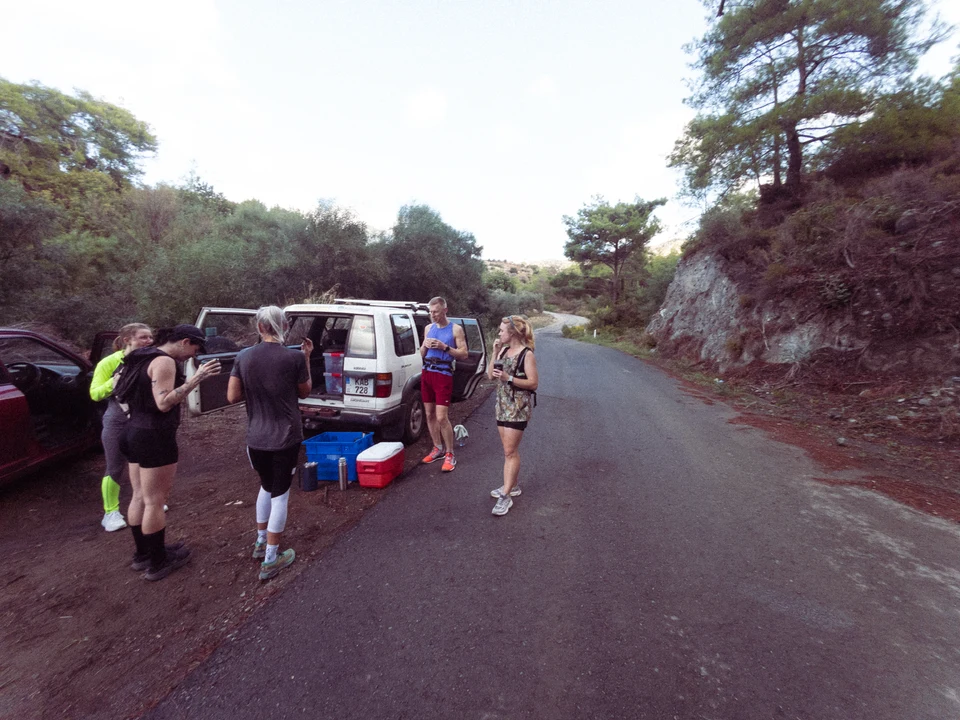
The best part might come at the end of the run, I always prepare a cold brew and bring the French press to prepare a hot brew on the spot. I try to use locally roasted coffees from different coffee places when I can to keep it interesting and it’s sort of another way of discovering the local coffee culture.
We asked for something only Culture Trails does. It took one line.
On the spot coffee out of the back of the car and homemade post run fuel.
We asked what a first trail run with them is like for someone who has only run on roads.
We move easy and really at a social pace and the idea is always to stick together and not too far apart. So even if you only have experience in hiking in this terrain or road running it’s always accessible and the main idea is to have a good time with people in a nice scenic environment and disconnect from the city even for just a little moment of your day or week.
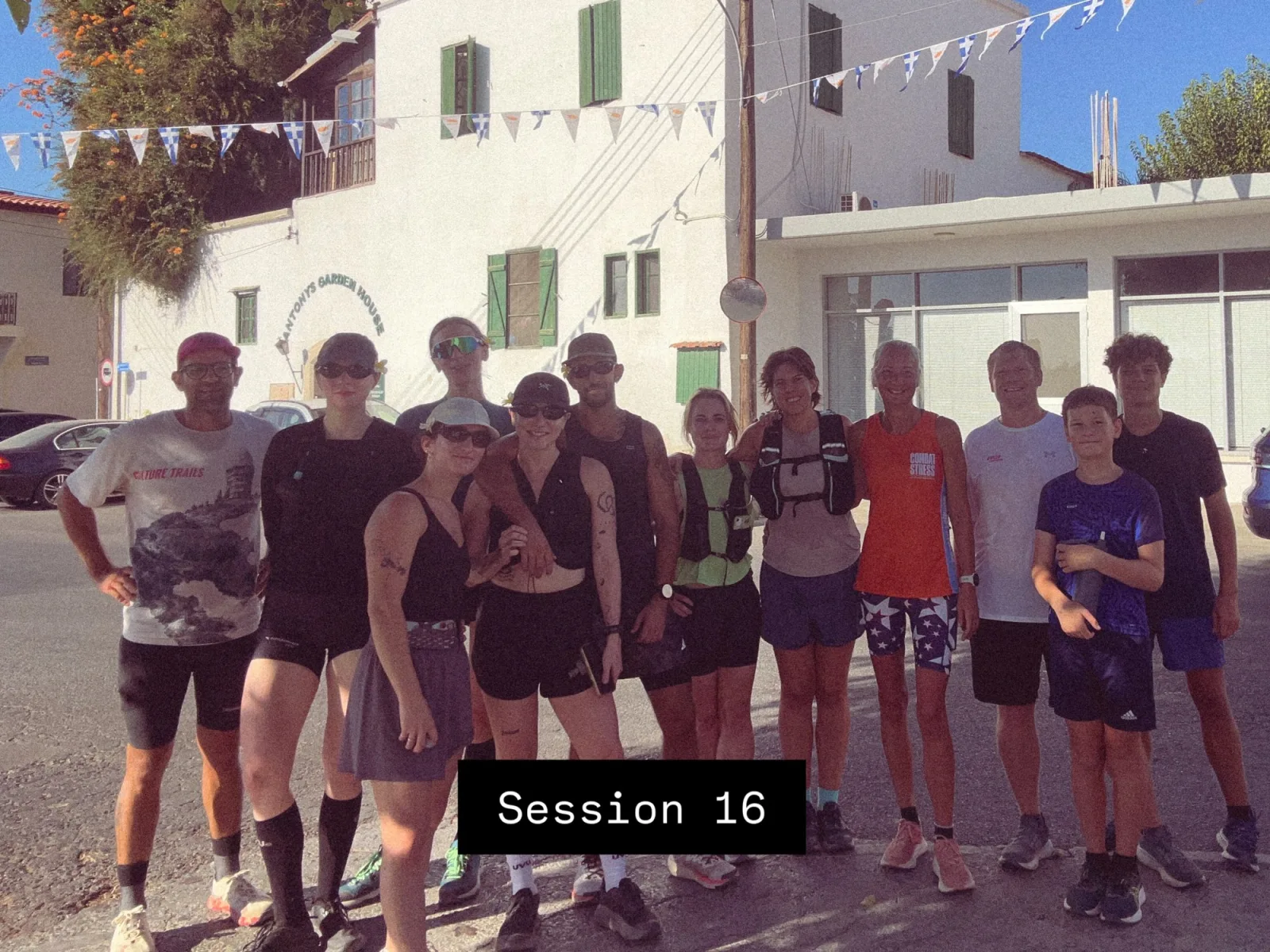
Their favourite trails start where the club did, in Apsiou.
Any of the trails from there leading to the Kakomalis fire look out are some of my favourite just because of the view you get once you are up there.
As the runs expand though, I feel this urge of curiosity of what trails I can find around what village and start hitting them all together. It’s such a great way to learn more about your Cyprus.
We asked for a run nobody in the club will forget.
I like to think that every run is different and the people that meet on that day are not always the same so that also makes it different and unique.
Last, we asked where in Cyprus they haven’t run yet but really want to.
Lately I have been getting lost on maps on my computer screen and have been dreaming of discovering trails deep in the Pafos forest and north of it as it feels like it could be some of the most remote parts in Cyprus. Let’s see if I get the green light from my wife!
Couch to Club is our series on Cyprus run clubs, told in their own words. Each one ends with how to run with them. Every episode